
You install a heat pump to use less energy and rely less on electric baseboards.
So why would you keep the baseboards?
In many homes, they still serve a useful purpose. They simply should not be doing most of the heating anymore.
With a ductless mini-split, existing baseboards often become supplementary heat for colder days and rooms the heat pump does not reach well.
A whole-home ducted heat pump works differently. Many central systems include electric supplementary heat inside the air handler, which means separate wall-mounted baseboards might no longer be necessary.
The right answer depends on your heat pump, your home and where you live in New Brunswick, Nova Scotia, Prince Edward Island, Newfoundland and Labrador, or British Columbia.
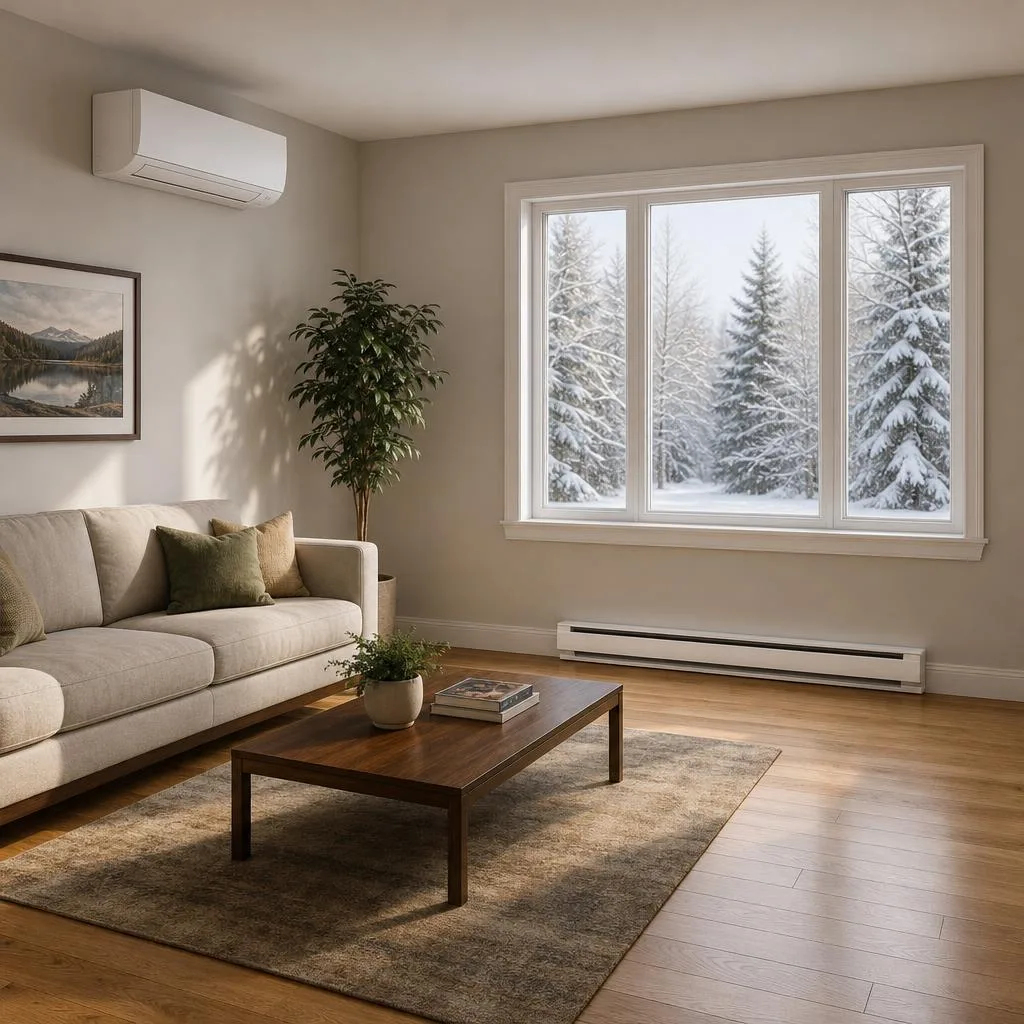
Heat Pump First, Baseboards Second
If you have both systems, the heat pump should usually do most of the work.
Electric baseboards use resistance heating. Electricity flows through an element and produces heat.
A heat pump moves heat instead.
That efficiency advantage disappears quickly if your baseboards are running beside the heat pump all day.
The better setup is simple:
- Use the heat pump as your main heating source.
- Keep baseboards lower.
- Let supplementary heat step in only when a room needs extra help.
What Temperature Should Baseboards Be Set To?
Do not set both systems to the same temperature.
If your heat pump and baseboards are both set to 21°C, they start competing with each other.
The baseboard thermostat might call for heat before the mini-split has finished warming the room.
A practical starting point looks like this:
- Heat pump: 21°C
- Baseboards: 18°C to 19°C
Your heat pump maintains your normal comfort level. The baseboards stay off unless the room drops below their lower setting.
New Brunswick and Newfoundland and Labrador publish similar advice, while Prince Edward Island recommends keeping supplementary heat a degree or two below the heat pump during cold weather.
Why Would a Modern Heat Pump Need Any Extra Heat?
Cold-climate heat pumps work at temperatures far below freezing.
Some models operate around -30°C.
That does not mean every heat pump produces enough heat for every house at -30°C.
Two things happen as temperatures fall.
Your home loses heat faster.
At the same time, an air-source heat pump generally has less heating capacity available.
Eventually those two numbers meet. This is known as the thermal balance point.
Below that point, supplementary heating fills the gap.
This is why the lowest operating temperature printed on a heat pump brochure does not tell you whether your home needs backup heat.
A unit might still operate at -25°C but produce less heat than your house needs at that temperature.
Supplementary Heat and Emergency Heat Are Not the Same Thing
These terms often get mixed together.
Supplementary heat helps the heat pump when its heating capacity is not enough to meet the home's full load.
Emergency backup heat is there for situations where the primary heating system stops working.
They are different jobs.
BC Hydro's current heat-pump design guidance makes this distinction clear. A properly sized cold-climate heat pump might need only a relatively small amount of supplementary heat during peak cold conditions rather than a second heating system sized to carry 100% of the house.
That difference matters when designing a new system.
Ductless Mini-Splits Usually Keep the Existing Baseboards
Ductless mini-splits are popular in homes with electric baseboard heat because they do not need ductwork.
An indoor head goes on the wall and heats the surrounding area.
In an open living room, kitchen and dining area, one properly placed head might cover a large part of the main floor.
Closed rooms are different.
A bedroom down the hallway with its door closed overnight gets much less heat from a living-room mini-split.
The same issue shows up in:
- Bathrooms
- Basement bedrooms
- Home offices
- Rooms at the opposite end of the house
- Spaces separated by several doorways
Existing baseboards give those rooms simple individual backup.
You do not need to run every baseboard at 21°C.
Leave them lower and let them operate only when those rooms need extra heat.
If you are planning this type of conversion, Greenfoot has a detailed guide to replacing electric baseboard heat with a ductless mini-split.
Central Heat Pumps Are Different
A centrally ducted heat pump distributes warm air throughout the home using ductwork.
Many all-electric central systems also include electric resistance elements in the air handler.
When outdoor conditions become too demanding for the heat pump alone, the system adds the extra heat automatically.
In this type of installation, keeping separate electric baseboards throughout the house might add little value.
The central system has already been designed with supplementary heating.
Greenfoot installs both ductless mini-splits and whole-home ducted heat pumps, so the backup strategy should match the system rather than follow one rule for every house.
| System type | Ductless heat pump | Central ducted heat pump |
|---|---|---|
| How heat is distributed | One or more wall-mounted indoor units heat nearby areas. Closed or distant rooms may receive less heat. | Ductwork distributes warm air through the home; coverage depends on system design and duct balancing. |
| Role of existing baseboards | They can provide room-by-room supplementary heat, especially in closed bedrooms, bathrooms and areas the heat pump does not reach well. | They may be unnecessary if the central system is designed for the home’s heating needs and includes adequate supplementary heat. |
| Supplementary heat | Existing baseboards can help when heat-pump capacity falls short or a room is less effectively served. | Electric resistance elements in the air handler may provide supplementary heat; confirm the system’s design and capacity. |
| Checks before removing baseboards | Have a qualified contractor confirm room coverage, cold-weather capacity and an emergency-heating plan. Do not remove them just because the heat pump keeps up in mild weather. | Ask for a heat-loss calculation confirming the complete system can cover the home at local design temperatures, including its supplementary heat and outage plan. |
Do You Need Baseboard Heat in New Brunswick?
With a ductless heat pump, keeping existing baseboards as supplementary heat generally makes sense.
The provincial program also makes an important point about cold-weather performance.
Many older or conventional heat pumps are rated around -15°C to -20°C. SaveEnergyNB recommends asking for cold-climate performance specifications when buying a new system and specifically points homeowners toward equipment rated to -25°C or lower with strong cold-weather efficiency.
For a ductless installation, baseboards provide useful protection on the coldest days and in rooms outside the main heat-pump zone.
For a properly designed central system, supplementary electric heat is often built in instead.
Do You Need Baseboard Heat in Nova Scotia?
Nova Scotia Power also recommends letting the heat pump lead.
The utility gives about 15°C, or several degrees below the heat pump, as an example backup setting.
You do not need to follow 15°C in every room.
A bedroom, bathroom or area containing vulnerable plumbing might need a higher minimum temperature.
The main idea is to stop the baseboards from competing with the heat pump.
Do You Need Baseboard Heat in Prince Edward Island?
PEI gives some of the clearest current homeowner advice.
During extreme cold, the province advises keeping supplementary heating available and setting those thermostats a degree or two lower than the heat pump.
This lets the heat pump continue working while the second system makes up any shortfall.
For a ductless mini-split home, existing baseboards fit this role well.
Do You Need Baseboard Heat in Newfoundland and Labrador?
Newfoundland and Labrador places more emphasis on keeping supplementary heat available with ductless systems.
TakeChargeNL states that a ductless heat pump is intended for an area where another heating source already exists, such as electric baseboards or a furnace.
The heat pump should still be the primary source.
TakeChargeNL recommends setting the backup system approximately 2°C lower so the systems do not compete.
Their winter guidance also recommends continuing to operate high-efficiency heat pumps during cold weather and allowing supplementary heat to step in when needed.
For a centrally ducted system, that supplementary heat is often already built into the equipment.
Do You Need Baseboard Heat in British Columbia?
B.C. needs a more regional answer because the province covers such a wide range of climates.
A home in Victoria has a different winter heating load from a home in Kamloops or another colder Interior community.
In colder regions, the need increases.
That supplemental heat might come from existing baseboards or electric resistance heat integrated into a central system.
Your Home Matters as Much as Your Province
Location tells only part of the story.
A well-insulated house needs less heat than a drafty house of the same size.
Heating demand changes with:
- Insulation levels
- Air leakage
- Windows and doors
- Home size
- Ceiling height
- Number of exterior walls
- Basement condition
- Local winter design temperature
This is why heat-pump sizing should start with a room-by-room heat-loss calculation instead of a simple square-foot rule.
An undersized heat pump forces supplementary heating to work more often.
Oversizing creates its own comfort and performance problems.
A Greenfoot heat pump assessment looks at the home, existing heating system, insulation and electrical setup before matching equipment to the space.
Can Better Insulation Reduce Your Need for Baseboard Backup?
Yes.
The less heat your house loses, the easier the heat pump's job becomes.
Air sealing and insulation reduce the heating load before the heating equipment does anything.
This becomes especially valuable during the coldest weather, when the difference between your home's heat loss and the heat pump's available capacity determines how much supplementary heat you need.
A home that once needed significant baseboard assistance might need much less after attic insulation, air sealing or other envelope improvements.
Greenfoot provides both heat pump systems and home energy-efficiency services, which makes it easier to look at the heating system and building envelope together.
Should You Remove Your Baseboard Heaters?
With a ductless system, there is usually little reason to rush.
A baseboard heater consumes no electricity when its thermostat is not calling for heat.
Leaving working baseboards in place gives you room-by-room supplementary heating without forcing you to use them.
Removal starts making more sense when:
- A whole-home ducted heat pump has been designed to replace them
- The new system already includes enough supplementary electric heat
- A heat-loss calculation confirms the complete system covers the home's heating needs
- The baseboards interfere with a renovation or new room layout
- Your HVAC contractor and electrician confirm they are no longer required
Do not remove backup heating simply because the mini-split keeps the house warm at 0°C.
The system needs to work when winter reaches its coldest conditions too.
What About Bedrooms With Closed Doors?
This is one of the biggest reasons homeowners keep some baseboards after installing ductless heat pumps.
A mini-split does not push heated air through ductwork into every room.
An open floor plan works in its favour.
A closed door works against it.
If your main indoor head sits in the living room, the bedroom at the other end of the hallway might stay noticeably cooler overnight.
You have several options:
- Keep the bedroom baseboard at a lower setting
- Add another ductless head
- Use a multi-zone system
- Choose a centrally ducted system
- Improve airflow between rooms where practical
For an existing home, leaving the bedroom baseboard in place is often the simplest option.
Should You Turn Baseboards Completely Off?
It depends on the room.
In the main area directly served by a heat pump, you might leave the baseboard off or set it low enough that it rarely runs.
Bedrooms, bathrooms, basement spaces and rooms with plumbing near exterior walls deserve more caution.
The goal is not to turn every baseboard off at all costs.
The goal is to keep electric resistance heat from running when the heat pump already has enough capacity to maintain comfort.
Should You Lower the Heat Pump at Night?
Large temperature setbacks often work poorly with heat pumps.
If a central heat pump has to recover several degrees quickly in the morning, the thermostat might call for electric resistance backup to help.
That reduces some of the savings you hoped to gain.
NRCan recommends moderate setbacks of no more than about 2°C for heat-pump systems.
TakeChargeNL similarly recommends keeping central heat pumps at a comfortable steady setting because large adjustments increase use of the less-efficient electric backup system.
Ductless systems have more flexibility because they usually do not contain built-in resistance backup, but your separate heating system should still remain below the heat-pump setting.
Does Backup Heat Mean the Heat Pump Is Too Small?
No.
A well-designed system does not always need to cover 100% of the home's heating requirement with the heat pump compressor alone.
In some climates, designing a heat pump to cover every possible extreme-cold hour would require larger equipment that spends most of the winter oversized.
BC Hydro's retrofit guidance specifically warns against automatically installing 100% supplementary backup without first calculating the home's heating load and the heat pump's balance point.
The goal is to size the whole system properly.
That might mean the heat pump provides nearly all annual heating while supplementary heat handles a small number of extreme-cold periods.
What Happens If the Heat Pump Breaks?
This is another reason some homeowners prefer keeping their existing baseboards.
Supplementary heat and emergency backup are different, but electric baseboards sometimes serve both roles.
If a ductless heat pump stops operating during winter, working baseboards give you another source of heat until the system is serviced.
That peace of mind has value in colder parts of Atlantic Canada and the B.C. Interior.
A central system needs its own emergency-heating plan, whether that comes from integrated resistance heat or another properly designed source.
So, Do You Need Baseboard Heating With a Heat Pump?
If you have a ductless mini-split, keeping existing baseboards as supplementary heat often makes sense.
Set them lower and let the heat pump do most of the work.
For a centrally ducted heat pump, separate wall-mounted baseboards are often unnecessary when the system already includes properly sized supplementary electric heat.
Climate still matters.
New Brunswick, Nova Scotia, Prince Edward Island and Newfoundland and Labrador all publish guidance supporting supplementary heat with ductless systems.
British Columbia varies more. A properly sized system in Victoria or Vancouver has different supplementary heating needs from a home in a colder Interior community.
The answer comes from the complete system:
- Your home's heat loss
- Your heat pump's cold-weather capacity
- Your floor plan
- Your local winter conditions
- How supplementary heat is designed
If you currently heat with electric baseboards and want to use them less, start with Greenfoot's guide to replacing baseboard heat with a ductless mini-split.
Or book a free heat pump assessment with Greenfoot Energy in New Brunswick, Nova Scotia, Prince Edward Island, Newfoundland and Labrador, or British Columbia.
Heat Pump and Baseboard Heating FAQs
Do I need baseboard heaters if I have a mini-split?
Keeping existing baseboards as supplementary heat often makes sense. Set them lower than the mini-split so the heat pump handles most of your heating.
What should I set my baseboards to with a heat pump?
Natural Resources Canada recommends setting electric supplementary heat about 2°C to 3°C below the heat pump. If your heat pump is set to 21°C, try the baseboards around 18°C to 19°C.
Can I remove my baseboards after installing a heat pump?
Do not assume they are unnecessary. With a ductless system, baseboards remain useful for closed rooms, extreme cold and emergency backup. A properly designed central system might replace them completely.
Do cold-climate heat pumps still need supplementary heat?
Some homes do. A cold-climate heat pump might operate near -30°C, but the need for supplementary heat depends on how much heating capacity the unit has at low temperatures compared with the home's heat loss.
Does needing backup heat mean my heat pump is undersized?
No. A properly designed system might intentionally use a small amount of supplementary heat during extreme conditions rather than oversizing the heat pump for a few unusually cold hours each year.
Is a heat pump cheaper to run than baseboard heaters?
Heat pumps use electricity more efficiently because they transfer heat instead of producing all of their heat through electric resistance. NRCan reports cold-climate air-source heat pumps provide space heating up to 2.5 times more efficiently than electric baseboards.
Should I turn my baseboards off completely?
In rooms directly served by the heat pump, you might turn them off or leave them at a low backup setting. Closed bedrooms, bathrooms, basement areas and spaces with vulnerable plumbing might still need a minimum setting.
Should I lower my heat pump at night?
A large overnight setback is usually unnecessary. NRCan recommends keeping setbacks moderate, around 2°C or less, because recovering several degrees quickly might trigger less-efficient supplementary heat.
Do central heat pumps need baseboard heaters?
Many central heat-pump systems include electric resistance heat inside the air handler. If the complete system is properly sized, separate wall-mounted baseboards might no longer be needed.
What is the thermal balance point of a heat pump?
The thermal balance point is the outdoor temperature where the heat pump's heating capacity matches the home's heat loss. Below that point, supplementary heat might be needed to maintain the indoor temperature.